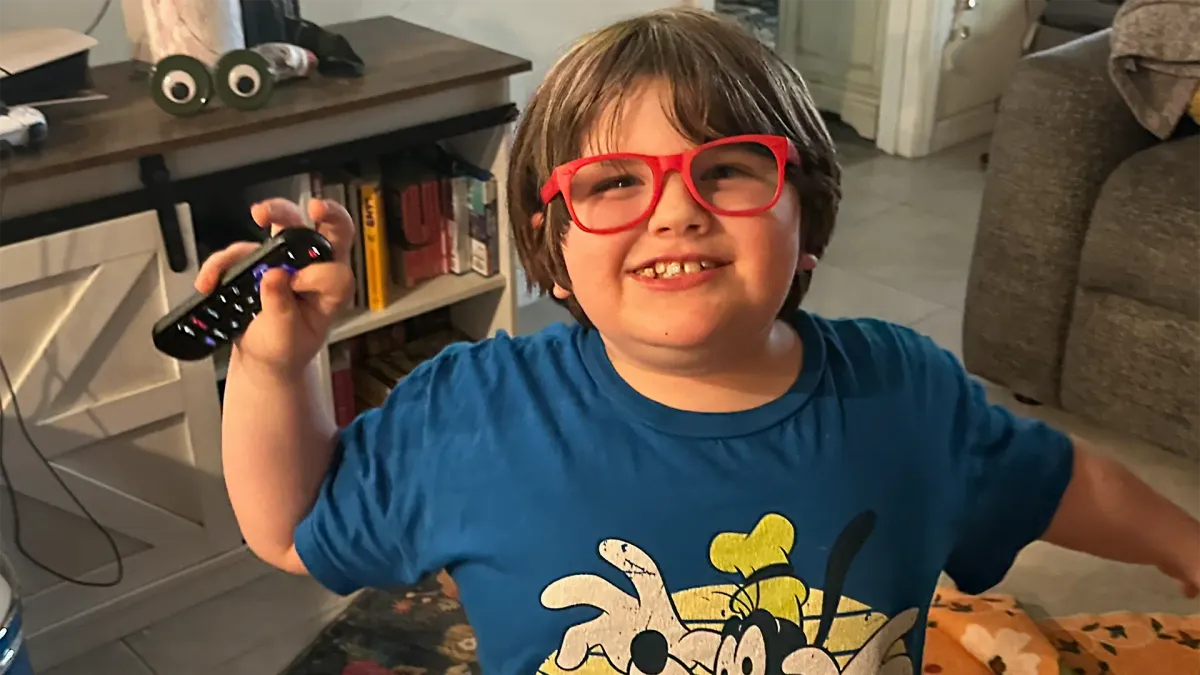
One of the first things people noticed about Elliot’s speech wasn’t what he said.
It was how he said it.
Instead of answering questions the way people expected, he often responded with lines from his favorite movies. Sometimes it was an entire conversation from a Disney film. Other times it was a phrase from YouTube, a commercial, or something Michael or I had said weeks earlier.
To someone unfamiliar with autism, it looked like he was simply repeating words.
To us, it was obvious he was communicating.
The challenge was no longer that he wasn’t talking.
The challenge was learning to understand the language he was already using.
For many years, echolalia was viewed as something that needed to be reduced or eliminated.
Today, we understand something much more important.
For many autistic people, echolalia isn’t non-functional speech.
It’s the foundation language is built upon.
And that foundation has a name.
Gestalt Language Processing.
There Isn’t Just One Way to Learn Language
Most of us were taught that children learn language one word at a time.
A baby says,
“Mama.”
Then,
“More.”
Then,
“Want cookie.”
Eventually those individual words become sentences.
This is often called analytic language processing, and it’s how many neurotypical children develop language.
They begin with the small pieces.
Words.
Then phrases.
Then sentences.
Like building a house one brick at a time.
Many autistic children build language differently.
Instead of starting with individual words…
They begin with whole phrases.
Whole songs.
Whole conversations.
Whole scripts.
Instead of collecting bricks, they’re handed entire walls.
Over time, those walls begin breaking apart into smaller, more flexible pieces.
That’s Gestalt Language Processing.
Neither approach is better.
They’re simply different paths to the same destination.
What Is a Gestalt?
A gestalt is a chunk of language that’s stored as one complete unit.
Imagine hearing the phrase,
“Ready, set, go!”
You probably don’t think about the individual words.
Your brain recognizes the entire phrase instantly.
That’s a gestalt.
For a Gestalt Language Processor (GLP), many phrases are learned this way.
Instead of learning the individual meanings of the words,
“Let’s go!”
becomes one complete idea.
So does,
“Time for bed!”
Or,
“Oh no, not again!”
Or an entire conversation from Finding Nemo.
Those phrases aren’t random.
They’re meaningful.
Even if the meaning isn’t obvious to everyone else.
Echolalia Is Communication
One of the biggest misconceptions about autism is that echolalia isn’t “real communication.”
I couldn’t disagree more.
Imagine someone asks Elliot,
“How are you feeling?”
Instead of saying,
“I’m nervous,”
he replies with a line from one of his favorite movies.
At first glance, that might seem unrelated.
But when we understand where the quote came from, something incredible happens.
Maybe that movie scene happened during a scary moment.
Maybe that character was overwhelmed.
Maybe the line represents excitement.
Maybe it represents uncertainty.
Suddenly the script isn’t random.
It’s incredibly specific.
He’s borrowing language that already carries the emotional meaning he wants to express.
That’s communication.
It’s just happening differently.
Scripts Are Often a Bridge, Not a Destination
I think one of the greatest gifts we can give Gestalt Language Processors is permission to use the language that’s available to them.
Too often, adults interrupt.
“Use your own words.”
“Don’t copy the movie.”
“Tell me the right answer.”
But what if those movie lines are their words?
What if those scripts are the very tools they’re using to build language?
When we honor those scripts instead of trying to eliminate them, something beautiful often happens.
Children begin expanding them naturally.
Language grows.
Not because we forced it.
Because we supported it.
It Isn’t Just About Movies
Many gestalts come from favorite movies or television shows.
But they can come from anywhere.
Parents.
Teachers.
Books.
Songs.
Commercials.
YouTube videos.
Even things we say every day without realizing it.
How many times have I heard myself coming out of Elliot’s mouth?
More than I can count.
Sometimes it’s humbling.
Sometimes it’s hilarious.
Sometimes it’s a gentle reminder that little ears are always listening.
Why Repetition Matters
If you’ve ever wondered why your autistic child wants to watch the same movie twenty-seven times…
Or listen to the same song on repeat…
Or quote the same conversation every day for months…
This may be part of the reason.
Repetition isn’t always about sameness.
It’s often about learning.
Every time a child hears that script, they’re gathering information.
Emotion.
Tone.
Timing.
Context.
Meaning.
Little by little, the brain begins organizing those pieces.
Language is growing.
Even when it doesn’t look like it from the outside.
Listening for Meaning Instead of Correctness
One of the biggest changes we’ve made in our family is this:
Instead of asking,
“Is that the right answer?”
We ask,
“What might Elliot be trying to tell us?”
That shift has transformed our conversations.
When he quotes a movie, we don’t immediately redirect him.
We get curious.
We think about where we’ve heard that phrase before.
What was happening in that scene?
How was the character feeling?
What just happened in Elliot’s day that might connect to that script?
More often than not…
The answer is there.
We just have to listen differently.
Language Isn’t a Test
I think adults sometimes forget that communication isn’t about producing the perfect sentence.
It’s about sharing ideas.
Feelings.
Needs.
Experiences.
Connection.
If a child successfully communicates using a movie quote, they’ve communicated.
Our job isn’t to erase the path they took.
It’s to meet them there.
How We Can Support Gestalt Language Processors
Supporting a GLP doesn’t require fancy programs or expensive materials.
It starts with changing how we think about language.
Instead of correcting every script…
Respond to the meaning behind it.
Instead of demanding one-word answers…
Model rich, natural language.
Instead of assuming repetition means no understanding…
Assume communication is happening and become a detective.
Observe.
Listen.
Stay curious.
Most importantly…
Presume competence.
Always.
Progress Doesn’t Always Look Like More Words
Sometimes progress looks like a child combining two familiar scripts into something new.
Sometimes it looks like changing one word in a favorite phrase.
Sometimes it looks like using the same movie quote in a brand-new situation because they’ve recognized a deeper connection.
Those moments matter.
They’re signs that language is becoming more flexible.
More meaningful.
More their own.
Growth doesn’t always happen in giant leaps.
Sometimes it happens one tiny change at a time.
Every Child Deserves to Be Heard
The older I get, the more I realize communication isn’t about speaking exactly like everyone else.
It’s about being understood.
Autistic children deserve communication partners who are willing to learn their language instead of insisting they immediately learn ours.
That means slowing down.
Listening more carefully.
Being curious instead of corrective.
Seeing scripts as bridges instead of barriers.
Because when we stop asking,
“How do I stop the echolalia?”
And start asking,
“What is my child trying to tell me?”
We often discover something remarkable.
They’ve been communicating with us all along.
We just needed to learn how to listen.
And maybe that’s the most important lesson Gestalt Language Processing has to teach us.
Communication isn’t only about the words we hear.
It’s about the meaning we’re willing to understand.
If you’d like to talk to our advocates about finding resources to help with language processing challenges, contact us today. We’re ready to help.